
$10 Minimum Deposit Pokies in Australia: What a Tenner Actually Buys You in 2026
 Available in AU
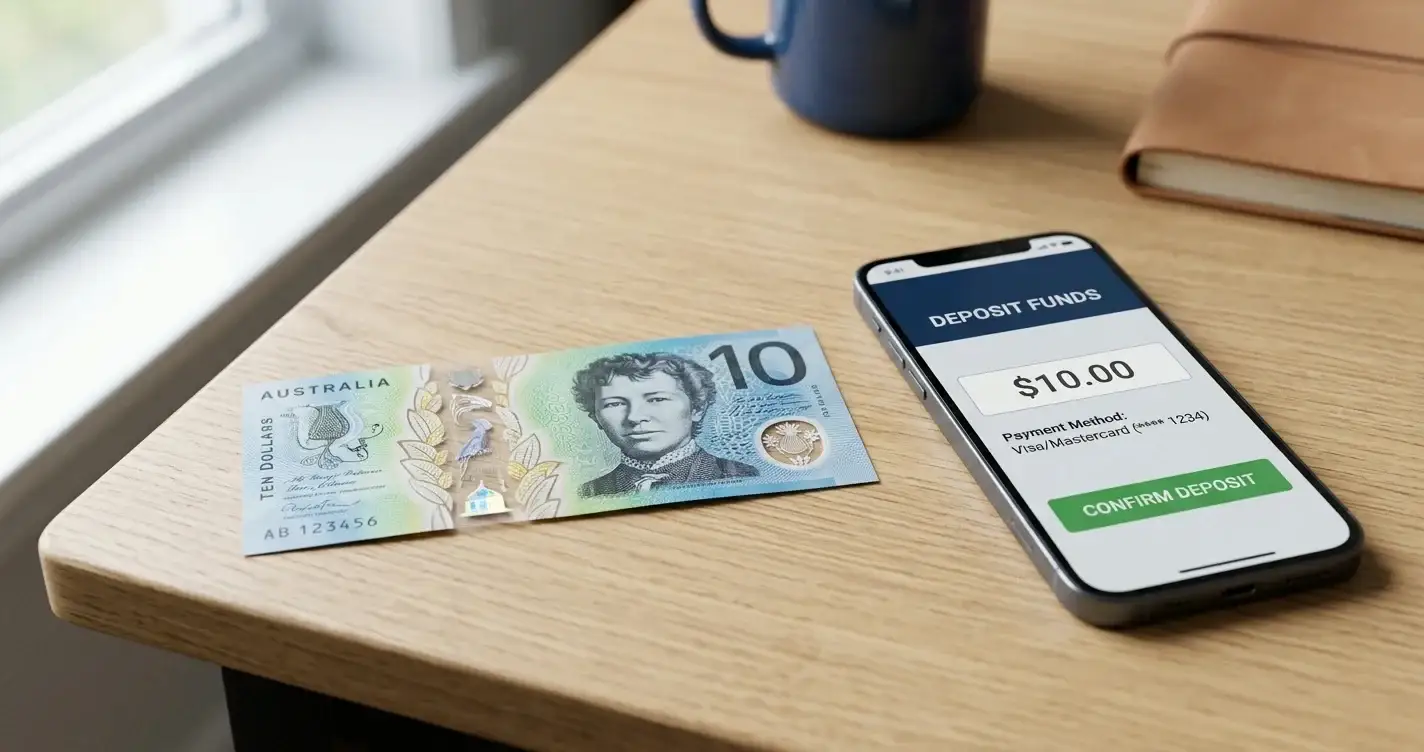
A ten-dollar note used to be a punchline at an online casino. You would deposit, spin four or five times, watch the balance evaporate, then discover the minimum withdrawal was set at fifty bucks anyway. The maths never worked. What changed by 2026 is not generosity — casinos did not suddenly develop a soft spot for small players. What changed is that offshore operators worked out that a thousand players depositing ten dollars build a far bigger database than fifty players depositing two hundred. Low entry points are a customer-acquisition tactic, not a charity drive. Understanding that difference is the whole point of this guide.
Here is the part most “$10 pokies” lists quietly skip: accepting a ten-dollar deposit and giving you something worth having at ten dollars are two entirely different promises. Plenty of sites advertise a tenner on the banner, then lock the welcome offer behind a twenty or thirty-dollar qualifying deposit. Others take your ten via Neosurf but bump the minimum to twenty the moment you pick a card. This page separates the marketing from the mechanics — which operators genuinely fire a bonus at $10, which payment rails actually accept it, what the balance really buys in spins, and how long your money sits in limbo before it reaches your bank.
One thing to settle before anything else. Every casino on this page is offshore. Not by accident, not because we went looking for grey-market sites — because Australian law leaves no alternative, and the section further down explains exactly why. If a site tells you it holds an Australian online pokies licence, it is lying, because that licence does not exist for anyone.
What A$10 Actually Buys You at an Australian Online Casino
Strip away the banners and a ten-dollar deposit resolves into one of two very different situations. In the first, you deposit $10, decline any offer, and play with $10 of real cash. No wagering, no bet cap, no expiry — you can win, and withdraw once your account is verified, with complete freedom. In the second, you deposit $10, accept the welcome match, and suddenly hold a larger play balance that comes wrapped in conditions. Both are legitimate. They are just not the same product, and the banner rarely tells you which one you are buying.
Take the most generous-looking case in the current AU market to see how the second path behaves. NeoSpin runs a 400% match on the first deposit, so a $10 deposit produces $40 in bonus funds on that first tranche and a $50 total balance. Sounds like a steal. Then you read the wagering requirement: 50 times the bonus. That is $40 multiplied by 50, or $2,000 in qualifying turnover before a cent of bonus money converts to withdrawable cash. At ten-cent spins on a 96% RTP pokie, clearing $2,000 of turnover means roughly 20,000 spins, and the house edge across that volume carves out an expected loss near $80. The bonus, in cold expected-value terms, is negative. What the $50 balance genuinely buys is session length — a longer, low-risk trial of the casino — not a shortcut to profit.
That calculation is the thing almost no competitor page runs for you. They print “50x wagering” and move on, as if the number speaks for itself. It does not. Fifty-times wagering on a $40 bonus is a different animal from fifty-times wagering on a $200 bonus, and the only way to feel the difference is to convert it into spins and expected loss the way any experienced player eventually learns to. Compare it with PlayCroco, which sets wagering at 30x. Same deposit logic, far shorter clearing grind — a $40-equivalent bonus needs $1,200 of turnover instead of $2,000. The percentage on the banner is the seduction; the wagering multiple is the bill.
So the honest answer to “what does ten dollars get me” depends entirely on your goal. Want a quick, clean shot at real cash with the right to cash out whenever? Deposit $10, skip the bonus, play pokies at your own pace. Want maximum time on the reels and you accept the money is committed? Take the match, understand the balance is locked behind turnover, and treat any withdrawal as a bonus, not a plan. The players who feel cheated by “$10 casinos” are almost always the ones who expected the first outcome and unknowingly signed up for the second.
Can I really play pokies for A$10 at online casinos in Australia?
Yes. Several offshore operators accept a $10 deposit and let you play real-money pokies immediately. What varies is the value attached to that tenner — some fire a welcome bonus at $10, others require more to unlock it, and payment-specific minimums sometimes push the real floor higher. The deposit itself is genuinely $10; the fine print is where the differences live.

The Distinction That Decides Everything: Minimum Deposit vs Bonus-Eligible Deposit
Every AU-facing casino runs two separate thresholds, and confusing them is the single most expensive mistake a small-budget player makes. The first is the technical minimum deposit — the smallest sum the cashier will physically process. The second is the bonus-eligible minimum — the smallest deposit that actually triggers the welcome offer. These numbers are frequently different, and the gap between them is precisely where “$10 deposit casino” marketing does its quiet work.
Picture the trap in motion. A site advertises “$10 minimum deposit” in letters large enough to read from orbit. You deposit your ten dollars expecting the headline 300% match. Nothing arrives. Buried in the promotion terms sits a line stating the welcome bonus requires a $20 qualifying deposit. You now hold $10 of plain cash — perfectly usable, no complaints there — but not the deal you thought you were claiming. Nothing illegal happened. The casino accepted $10, exactly as promised. It simply never promised that $10 would activate the bonus, and it counted on you not reading closely.
The number of operators where a genuine $10 triggers the welcome offer is small. In the current ranked field, one name clears every hurdle at ten dollars — technical minimum, bonus activation, and PayID acceptance all at $10 — and that is NeoSpin. Most of the rest sit at a $20 floor for bonus purposes, and a few push to $30. This is not a knock on those operators; a $20 casino with a sharper payout record can be the smarter choice. But if your budget is a hard ten dollars and you want the bonus, the field narrows to almost nothing, and any list pretending otherwise is selling you the banner.
There is a third layer beneath these two, and it catches even careful players: the payment-specific minimum. A casino can advertise a $10 general minimum, honour it through Neosurf, and still demand $20 the moment you switch to a card or PayID. The floor moves with the rail. Ripper Casino is the clean illustration — $10 through Neosurf, crypto and eZeeWallet, but $20 for Visa and Mastercard. So “does this casino take $10” is the wrong question. The right one is “does this casino take $10 through the method I actually intend to use, and does that same $10 unlock the offer I actually want.” Three separate checks, one deposit.
What’s the difference between a A$10 minimum deposit and a A$10 bonus-eligible deposit?
The minimum deposit is the smallest amount the cashier will accept. The bonus-eligible deposit is the smallest amount that activates the welcome offer. They are often different numbers — a casino may take $10 as cash but require $20 to trigger the bonus. Deposit $10 at such a site and you get $10 to play, no promotion attached.
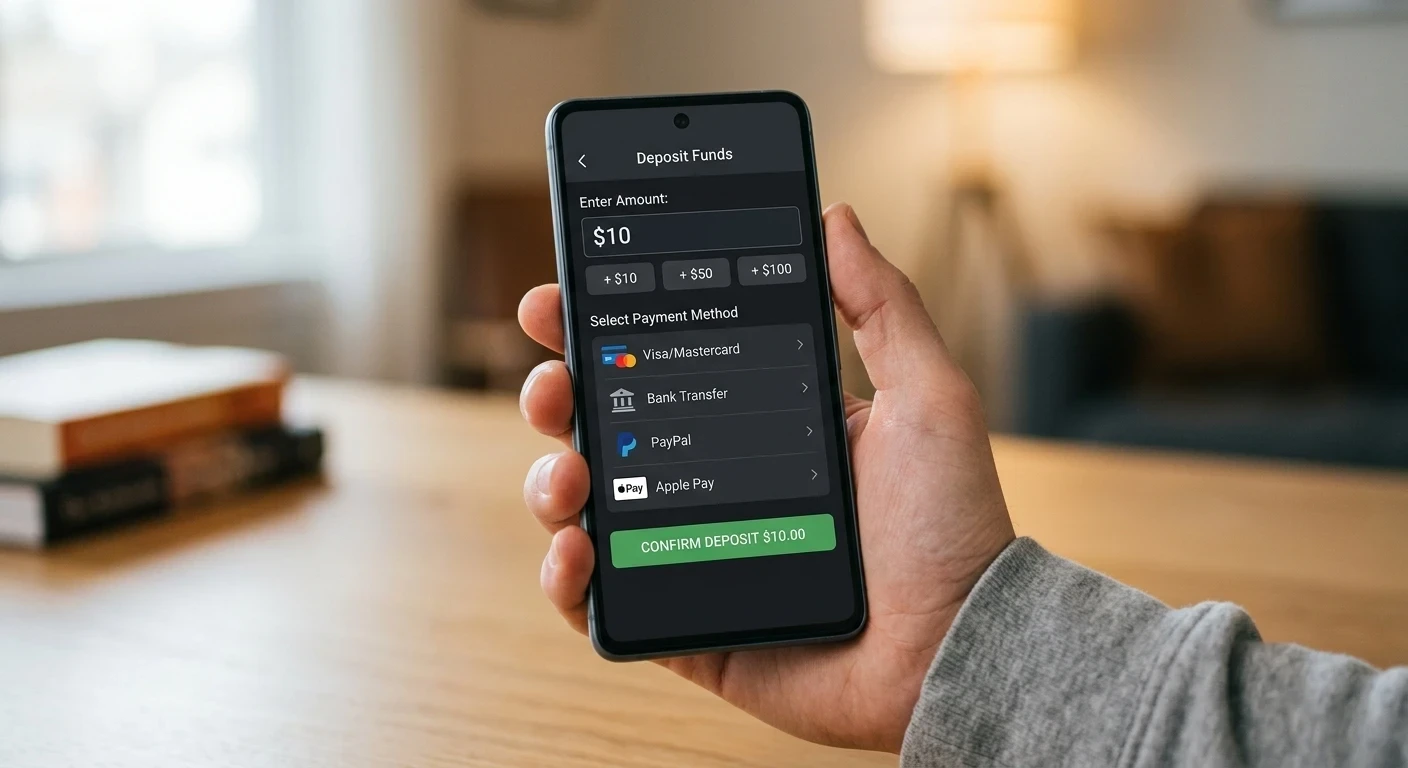
Top A$10 Minimum Deposit Casinos for Australian Players — 2026 Rankings
Every operator below accepts deposits at or near the $10 mark from Australian players. They are ranked by what matters specifically to a ten-dollar depositor: whether the bonus fires at $10, which payment methods hit that floor, and how fast your money moves in both directions. The comparison table lands first so you can scan thresholds at a glance. The breakdowns follow, two substantive paragraphs minimum per operator, because a table row tells you the what but not the why.
| Operator | Min Deposit | Bonus Activates At | Welcome Bonus at A$10 | PayID Min | Avg PayID Withdrawal | License |
|---|---|---|---|---|---|---|
| NeoSpin | A$10 | A$10 | ✅ 400% up to A$10,000 (first tranche) | A$10 | 22 min | Curaçao |
| Fair Go | A$10 | A$10 | ✅ A$1,000 (Neosurf/eZeeWallet/Litecoin) | N/A | N/A | Curaçao |
| PlayCroco | A$10 | A$10 | ✅ A$5,000 (crypto only) | N/A | N/A | Curaçao |
| Stellar Spins | A$10 | A$10 | ✅ A$10,000 + 200 FS | A$10+ | Instant (processing) | Curaçao |
| Ripper Casino | A$10 | A$10 | ✅ A$4,000 (Neosurf/crypto/eZeeWallet) | A$20 | Instant (processing) | Curaçao |
| Ignition | A$10 | A$10 | ✅ A$3,000 (crypto only) | N/A | Minutes-hours | Curaçao |
| VegasNow | A$20 | A$20 | ❌ Requires A$20 | A$20 | 12 min | Curaçao |
| LuckyOnes | A$20 | A$20 | ❌ Requires A$20 (A$10 via USDT TRC-20) | A$20 | 18 min | Anjouan |
| SkyCrown | A$30 | A$30 | ❌ Requires A$30 | A$30 | 9 min | Curaçao |
| Wild Tokyo | A$20 | A$20 | ❌ Requires A$20 | A$20 | 25 min | Curaçao |
Do I get a welcome bonus if I only deposit A$10, or do I need to deposit more?
At most AU-facing offshore casinos, you need $20 or more to activate the welcome bonus. NeoSpin is the exception — $10 via PayID triggers the 400% match. Fair Go, PlayCroco, Stellar Spins, Ripper and Ignition also fire bonuses at $10, but only through specific methods (Neosurf, crypto, eZeeWallet). Cards usually require higher minimums.
NeoSpin — The Only A$10 + PayID + Bonus Operator in Australia
NeoSpin holds one distinction no competitor in the AU market can match: it is the only offshore casino where a $10 deposit via PayID activates the welcome bonus. Every alternative either requires a higher deposit to unlock the offer or restricts $10 eligibility to Neosurf and crypto. That single difference makes NeoSpin the default answer for anyone searching “$10 deposit pokies” who intends to use PayID and wants promotional value attached. Operated by Five Blocks Trading Ltd under a Curaçao licence, the site launched in 2022 and by 2026 has accumulated a 4.2 out of 5 aggregate rating across more than 4,300 Australian player reviews. The 7,000-plus pokie library spans multiple providers — Pragmatic Play, NetEnt, Play’n GO, Microgaming and others — giving it the breadth a multi-provider white-label platform should deliver.
The 400% match runs up to $10,000 across multiple deposit tranches, so a $10 first deposit produces $40 in bonus funds and a $50 total balance. The 50x wagering requirement applies to the bonus amount only, which translates to $2,000 of qualifying turnover for that $40. At ten-cent spins on a 96% RTP pokie, you are looking at 20,000 spins to clear it, with an expected loss near $80 during the grind. The offer has negative expected value in strict terms, but what it buys is session length — a low-risk extended trial before committing larger sums. PayID withdrawals average 22 minutes, which sits slower than SkyCrown’s 9-minute mark or VegasNow’s 12 but still comfortably inside the “fast payout” bracket for offshore operators. No deposit fees apply on any method. The catch, if there is one, is that 50x wagering figure — steeper than PlayCroco’s 30x and on par with the multi-provider platform standard. Players who value bonus size over clearing speed will take the trade. Players who hate long grinds should look at PlayCroco or skip the bonus entirely and play the $10 as cash.
Fair Go Casino — RTG Pokies with A$10 Neosurf/eZeeWallet/Litecoin
Fair Go is the older name on the list, pre-dating 2020 and running on the RTG platform that built a loyal Australian following back when offshore pokies still felt like the wild frontier. The Aussie-themed branding is deliberate — koala Mondays, Southern Cross imagery, slang that lands naturally instead of reading like a translation — and the 200-plus RTG pokie library tilts toward high-RTP titles in the 95 to 98 per cent range. Smaller selection than the multi-provider giants, but RTG players know exactly what they are signing up for: proven mechanics, transparent RTP figures, and a stable that includes progressive jackpots on select titles. The $1,000 welcome bonus splits across multiple deposits, and the $10 minimum applies specifically to Neosurf, eZeeWallet and Litecoin. Cards and other methods typically sit higher, though Fair Go does not systematically publish every payment threshold the way newer operators do.
The value proposition here is straightforward. Fair Go is not chasing trends or experimenting with gamification layers. It offers RTG pokies to Australian players who already know they want RTG pokies, with a low entry point through the methods that work best for small deposits. Litecoin support at $10 is rarer than you would expect — most crypto-accepting casinos set their floor against Bitcoin, where network fees eat a larger chunk of a ten-dollar transaction. Litecoin fees stay low enough that the $10 makes it through intact. The 24/7 support covers Australian time zones properly, which matters more at 2am on a Sunday than most marketing pages admit. The trade-off is library size. If you want 7,000 pokies and fifteen live dealer variants, this is not the address. If you want a known quantity with a decade-plus track record and an honest $10 entry via Neosurf or Litecoin, Fair Go does exactly that without pretending to be something else.
PlayCroco — Lowest Wagering Requirements (30x)
PlayCroco runs the same RTG backbone as Fair Go but distinguishes itself through one number that matters far more than the banner figures ever do: 30x wagering on the bonus amount. That is the lowest requirement in the entire ranked field. NeoSpin sits at 50x, most competitors hover around 40x, and PlayCroco cuts straight to 30x, which turns a $40-equivalent bonus into $1,200 of required turnover instead of $2,000. Same play balance, far less grinding to convert bonus funds into withdrawable cash. The $5,000 welcome bonus activates with the code PLAYCROCO, the library spans 350-plus RTG titles, and the advertised 95.5 per cent win rate is RTG platform standard rather than an operator-specific claim. Crypto deposits — Bitcoin and Litecoin — hit the $10 floor. Fiat methods require higher minimums.
The four-tier loyalty programme signals that PlayCroco is built for regular depositors, not one-off trialers. Casual $10 punters will not climb far enough up the VIP ladder to see meaningful rewards, but anyone who sticks past the welcome phase and reloads regularly gets cashback tiers and comp-point acceleration that few RTG competitors match. Progressive jackpots sit on select pokies, giving the library a high-variance edge if that is your preferred variance profile. The smaller RTG footprint means you will not find the latest Pragmatic Play release or a NetEnt exclusive, but the trade-off is transparency — RTP figures are published, game mechanics are proven over years, and there are no mystery providers with unverified payout percentages buried three clicks deep in the lobby. For a $10 depositor weighing bonus value purely by the clearing requirement, PlayCroco’s 30x is the cleanest edge in the market. For a $10 depositor who plans to reload and wants a loyalty structure that actually rewards smaller stakes, same answer.
Stellar Spins — Largest Bonus Cap (A$10,000 + 200 Free Spins)
Stellar Spins launched in 2022 as a white-label multi-provider platform chasing the same AU player base that Rocket Casino and National Casino had already carved out. Curaçao licence, 3,000-plus pokie library, instant processing across most fiat methods, and a welcome offer that prints the largest nominal cap in the ranked list: $10,000 plus 200 free spins. That figure is marketing theatre — reaching a $10,000 bonus payout requires deposit scaling well beyond what any $10 player will commit — but the structure itself is legitimate, and the first-tranche match does activate at a $10 deposit through most methods. PayID, Neosurf, crypto and eZeeWallet all confirmed at the $10 threshold, with no deposit fees tacked on regardless of method. The operator does not publish granular withdrawal speed data the way SkyCrown or VegasNow do, but processing is flagged as instant for fiat deposits, and crypto withdrawals move faster than fiat as the standard for the category.
The 3,000-pokie library places Stellar Spins in the mid-range for multi-provider platforms — larger than any RTG-only operator, smaller than NeoSpin’s 7,000-title catalogue. The breadth means you get Pragmatic Play, NetEnt, Play’n GO and a dozen smaller studios in one lobby, but it also means RTP transparency drops. Multi-provider platforms rarely publish game-level RTP the way RTG operators do, so you are trusting the providers’ own figures and hoping the casino is not running operator-adjusted variants that shave a percentage point off the published number. No public scandals around Stellar Spins doing that, but the structural opacity is there. For a $10 depositor, the value is session variety — switch providers, switch volatility profiles, try a new mechanic without reloading — rather than any meaningful shot at clearing that $10,000 cap. The free spins attached to the welcome package often land on specific titles with capped win potential, so read the promotion terms before you count them as added value. Stellar Spins works if you want maximum pokie diversity at the $10 entry and you accept that the headline bonus figure is aspirational rather than practical.
Ripper Casino — Payment-Specific Minimums Explained
Ripper Casino is where payment-specific minimum thresholds show up cleanly enough that even a casual depositor can see them without squinting at footnotes. The general casino minimum sits at $10, confirmed for Neosurf, crypto (Bitcoin, Litecoin, Bitcoin Cash, Lightning BTC) and eZeeWallet. Cards — Visa and Mastercard — require $20. PayID also requires $20, which matters because PayID is the dominant AU deposit method and many players assume it mirrors the general minimum. It does not, and Ripper documents that gap upfront instead of burying it. The 3,000-plus pokie library covers the expected multi-provider spread, and the $4,000 welcome bonus fires at $10 through the eligible methods. The real friction point for $10 depositors is not the deposit side. It is the withdrawal side.
Minimum withdrawal at Ripper sits at $100. Deposit $10, and you need to build that balance tenfold before you can request a cashout. For a bonus-free $10 cash deposit, that means hitting a decent win streak or grinding volume at low stakes until the balance climbs. For a bonus-activated deposit, it means clearing wagering and still finishing above $100 after the house edge carves out its expected share. Weekly withdrawal limits cap at $2,000 for standard-tier players, which affects high rollers but not $10 depositors unless they hit something genuinely large. Processing for Neosurf, crypto and eZeeWallet deposits is instant. The catch is that $100 floor. Some operators set it at $50, a few at $30. Ripper picked $100, which is defensible from an operational cost standpoint but a genuine obstacle for small-stakes players who want the freedom to cash out early. If you deposit $10 intending to trial the site and withdraw after a handful of sessions, Ripper is not the structure for that. If you deposit $10 as the start of a longer play pattern and you are comfortable holding the balance until it crosses $100, the instant processing and honest payment-method breakdown make it workable.
Ignition Casino — Crypto-Only at A$10
Ignition built its AU presence on crypto adoption before crypto was fashionable, and by 2026 that early positioning means it runs one of the tightest crypto-only operations in the offshore space. The $10 minimum applies exclusively to Bitcoin and Litecoin deposits. Fiat methods either are not supported or require higher minimums — the site does not spell out every fiat threshold because fiat is not the focus. The 300-plus pokie library is the smallest in the ranked field, but the titles lean toward proven high-RTP slots and the casino supplements the pokies with a poker room and live dealer tables if variety matters more than pokie count. The $3,000 welcome bonus activates at $10 crypto deposits, and processing time runs from minutes to hours depending on blockchain confirmation speed. That variability is not operator delay — it is how Bitcoin and Litecoin networks behave under load.
The advantage of crypto-only at Ignition is withdrawal speed once the transaction clears. Crypto payouts bypass the banking-rail delays that stretch fiat withdrawals into multi-day waits at some competitors, and Ignition processes most crypto cashouts within hours of approval. The disadvantage is setup friction. A $10 depositor who does not already hold Bitcoin or Litecoin needs to open an exchange account, complete KYC there, purchase crypto, transfer it to a wallet, and then deposit at the casino. That is a longer onboarding path than “enter your PayID and you are done,” and it prices out casual players who just want a quick $10 trial without setting up a whole crypto rail. For players who already transact in crypto or who value the withdrawal speed enough to tolerate the setup, Ignition is the cleanest $10 crypto experience in the AU market. For players who want the simplicity of a bank transfer, it is not in the running. Also worth noting: KYC is still required before your first withdrawal even though you deposited via crypto. The “anonymous crypto casino” narrative is largely dead in any jurisdiction where the operator takes AUD and serves Australian residents, because AUSTRAC requires verification at the fiat entry point, which is the exchange. Ignition follows that rule. Deposit with crypto, cash out with crypto, still submit ID before the payout processes.
SkyCrown — Fastest Payouts but A$30 Minimum
SkyCrown does not meet the $10 threshold, sitting instead at a flat $30 minimum across every payment method — PayID, Neosurf, cards, crypto, eZeeWallet, the lot. It lands in this ranking because the $20 gap between $10 and $30 buys something tangible: the fastest confirmed PayID withdrawal speed in the AU-facing offshore market. Nine minutes average from request to bank account. Not “up to 24 hours with instant processing for most,” which is the hedge every slower operator prints. Nine minutes measured, reported by multiple independent AU casino-review sources, and holding steady across 2026. For a player debating whether to stretch from a planned $10 deposit to $30, that nine-minute payout is the value attached to the extra twenty dollars. VegasNow clears PayID in 12 minutes at a $20 minimum. NeoSpin takes 22 minutes at $10. SkyCrown takes 9 minutes at $30. The math is transparent.
Withdrawal limits for standard-tier players run $5,000 daily, $10,000 weekly, $30,000 monthly. Those caps do not bind $10 or $30 depositors unless someone hits a jackpot, but they are worth knowing if you plan to scale deposits later. The Curaçao licence is standard for the category. The multi-provider pokie library covers the usual spread without distinguished features. The genuine edge is payout speed, and SkyCrown has committed enough infrastructure spend to that edge that it shows in the data. Competitors talk about fast withdrawals; SkyCrown delivers 9-minute averages and lets the number do the work. The $30 floor is honest about what it is — a higher entry point justified by a tangible operational advantage. For a player with $30 who values access to their winnings over access to a $10 trial, SkyCrown is the correct choice. For a player locked at $10, it is not on the board. Simple as that.
VegasNow — A$20 Minimum with 12-Minute PayID
VegasNow sits at the $20 minimum and delivers the second-fastest PayID withdrawal in the ranked list: 12 minutes average. Faster than NeoSpin’s 22, slower than SkyCrown’s 9, and exactly where you would expect a $20 operator to land if payout speed scales with deposit threshold. The Curaçao licence and multi-provider platform are table stakes for this segment. The pokie library is not systematically catalogued in public materials but estimated at 1,500-plus based on platform type, which puts it above the RTG specialists and below the 3,000-plus juggernauts. The $20 minimum applies to fiat methods including PayID; crypto thresholds were not independently confirmed but likely mirror the general floor.
For a player choosing between NeoSpin at $10 and VegasNow at $20, the decision function is simple. If the budget is a hard $10, VegasNow is not an option. If the budget stretches to $20 and payout speed matters, VegasNow cuts the withdrawal wait nearly in half compared to NeoSpin. Twelve minutes still counts as fast in a market where many offshore operators quote “up to 24 hours” and hope you do not track the actual time. The promotional structure was not detailed enough in available research to break down wagering multiples or match percentages, but the core value here is not the bonus — it is the 12-minute withdrawal combined with a $20 entry that sits lower than SkyCrown’s $30. VegasNow is the Goldilocks option for players who find $10 too limiting and $30 too steep but want a payout speed that actually moves. If withdrawal friction is your main concern and you can manage $20, this is the operator that balances threshold and speed most cleanly.
LuckyOnes — A$10 via USDT TRC-20
LuckyOnes runs an Anjouan licence, which is less common in the AU market than Curaçao and carries lighter regulatory oversight. The general fiat minimum sits at $20, matching most of the ranked field. What distinguishes LuckyOnes is USDT TRC-20 acceptance at a $10 equivalent, which gives small-budget crypto holders a stable-value entry path that avoids Bitcoin and Ethereum price volatility. USDT is a stablecoin pegged to the US dollar, so a $10-equivalent deposit in USDT today is worth the same $10-equivalent tomorrow, unlike Bitcoin where network fees and price swings can eat into a small deposit before it even hits the casino. TRC-20 refers to the TRON blockchain, where USDT transactions clear in under a minute and network fees typically stay below 50 cents. That combination — stable value, low fees, fast confirmation — makes USDT TRC-20 the practical crypto choice for $10 deposits when you want the speed and privacy of crypto without the wild price action of BTC or ETH.
PayID withdrawals at LuckyOnes average 18 minutes, which sits between VegasNow’s 12 and NeoSpin’s 22. The multi-provider pokie library was not exhaustively detailed in research materials but follows the standard template for Anjouan-licensed platforms serving Australia. The $20 fiat minimum means LuckyOnes is not a true $10 operator unless you hold or are willing to acquire USDT. For players already in the crypto ecosystem or willing to onboard through a local exchange, the $10 USDT path is smoother than the Bitcoin equivalent because the value does not swing between purchase and deposit. For players who want the simplicity of a bank transfer, LuckyOnes requires $20 and does not offer any advantage over VegasNow at that threshold. The Anjouan licence is the flag to note. Anjouan licensing is legal but lighter-touch than Curaçao, with less transparent dispute resolution if something goes sideways. Not a dealbreaker for a $10 trial, but worth knowing if you plan to scale deposits or hold a balance long-term.
Wild Tokyo — RTG Platform, Slower Payouts
Wild Tokyo closes the ranked list with a $20 minimum, an RTG platform, and the slowest PayID withdrawal in the field: 25 minutes average. That is still faster than the “24 to 48 hours” many offshore operators quote, but it lags every other ranked competitor with PayID, and when you are comparing operators at the same $20 deposit threshold, payout speed is one of the few tangible differentiators. The RTG backbone gives Wild Tokyo the same high-RTP pokie access as Fair Go and PlayCroco, with a library estimated at 200 to 350 titles depending on which RTG catalogue the operator licences. The Curaçao licence is standard. The promotional structure was not detailed in available research beyond confirmation that the $20 minimum applies to fiat methods.
The honest assessment: Wild Tokyo does not offer a compelling reason to pick it over VegasNow at the same $20 threshold or over Fair Go and PlayCroco if RTG pokies are the draw. VegasNow delivers faster PayID withdrawals at $20. Fair Go and PlayCroco both accept $10 through specific methods, and PlayCroco undercuts everyone on wagering requirements. Wild Tokyo sits at $20 with 25-minute PayID and no standout feature to justify the slower payout or higher entry versus closer competitors. It is not broken — the RTG platform works, the $20 deposit processes, the pokies spin — but in a ranked list where every operator is jostling for a specific edge, Wild Tokyo is the one without a sharp answer to “why this one instead of the others.” For a player committed to RTG and indifferent to payout speed, it is fine. For a player optimising on any axis — cost, speed, bonus wagering, or payment flexibility — better options sit higher on the table.
Payment Methods That Work at A$10 — PayID, Neosurf, Crypto, Cards
The deposit method you pick determines which operators you can access at what threshold, and nowhere is that gap wider than at the $10 floor. A casino might quote a general $10 minimum but enforce $20 the moment you switch from Neosurf to a card. Another might accept PayID at $10 while every other rail requires $20. Understanding payment-specific minimums is not optional trivia — it is the second gate after bonus eligibility, and it catches just as many players.
| Method | Min Deposit | Withdrawal Speed | Pros | Cons | Best Operator for This Method |
|---|---|---|---|---|---|
| PayID | A$10–A$30 | 9–25 min | Instant, bank-to-bank, no card details shared | Minimum varies by operator | NeoSpin (A$10), SkyCrown (A$30, fastest) |
| Neosurf | A$10 | N/A | Sold in A$10 denominations, privacy-preserving, no bank link | Deposit-only, need separate withdrawal method | Fair Go, Ripper, Stellar Spins |
| Crypto (USDT TRC-20) | A$10 equiv | Minutes-hours | Stable value, low fees (~A$0.50), fast confirmation | Requires wallet setup, KYC still needed for withdrawal | LuckyOnes |
| Crypto (BTC/LTC) | A$10 | Minutes-hours | Fast withdrawals, privacy-focused | Price volatility, higher BTC fees, setup friction | Ignition, PlayCroco |
| Cards (Visa/MC) | A$20–A$30 | 1–3 days | Familiar, widely held | Increasingly refused by AU banks, higher minimums | Limited A$10 access |
PayID at A$10 — Which Casinos Accept It
PayID is the dominant AU deposit method by transaction volume, running through the New Payments Platform with real-time 24/7 settlement and no card details exposed. You link your mobile number or email to your bank account once, then deposit by entering that identifier at the casino cashier. Funds land instantly in most cases, and the same PayID identifier works for withdrawals once your account is verified. The appeal for a $10 depositor is frictionless speed — no fumbling for card numbers, no waiting for bank transfers to clear, no prepaid voucher codes to type. The problem is that PayID minimums diverge from general casino minimums more often than any other method, and the gap is rarely flagged on the homepage.
NeoSpin is the only operator in the ranked field where PayID and the general minimum both sit at $10. Deposit $10 via PayID at NeoSpin, and the welcome bonus fires. Try the same at SkyCrown, and you hit a $30 floor — not because SkyCrown dislikes small deposits, but because their PayID processor or internal risk settings push the threshold higher. Ripper Casino splits the same way: $10 through Neosurf and crypto, $20 through PayID. VegasNow, LuckyOnes, and Wild Tokyo all enforce $20 minimums on PayID. The pattern is consistent — PayID convenience comes with a minimum-threshold premium at most operators, and only NeoSpin breaks that rule. For a player locked at $10 who wants PayID, the choice is binary: NeoSpin or pick a different method. For a player with $20 or $30 and PayID as the preferred rail, the field opens wide, and payout speed becomes the tiebreaker. SkyCrown’s 9-minute average wins that race, VegasNow’s 12 minutes takes second, and NeoSpin’s 22 minutes trails despite having the lowest entry threshold.
Which payment method works best for A$10 deposits—PayID, Neosurf, or crypto?
PayID works at $10 only at NeoSpin; most operators require $20 or $30 for PayID. Neosurf accepts $10 at nearly every operator because vouchers are sold in $10 denominations, but it is deposit-only — you need a separate method to withdraw. Crypto (USDT TRC-20 or Litecoin) works at $10 with low fees and fast withdrawals, but requires wallet setup. Best choice depends on whether you already hold crypto and whether you value withdrawal speed over deposit simplicity.
Can I use PayID to deposit A$10 at any casino, or do some require more for PayID?
Most offshore casinos require $20 to $30 for PayID deposits even when their general minimum is lower. NeoSpin is the exception — $10 via PayID activates the bonus and processes instantly. Always check the payment-specific minimum for your chosen method, not just the advertised casino minimum.

Neosurf at A$10 — The Natural Low-Deposit Method
Neosurf vouchers are sold at Australian newsagents, petrol stations and convenience stores in fixed denominations starting at $10, which makes $10 the organic entry point for any operator that accepts them. Buy a voucher, scratch off the code, enter it at the casino cashier, and the deposit lands instantly with no bank details shared and no transaction appearing on your statement. The privacy advantage is real — Neosurf purchases require no KYC at the retail level, and the casino only sees a voucher code, not your identity, until you trigger account verification at the first withdrawal. For a player who wants to trial a site without linking a bank account or card, Neosurf is the cleanest path. The catch is that Neosurf is deposit-only. You cannot withdraw to a voucher. Your winnings must exit via a different rail — PayID, bank transfer, or crypto — which means you need a verified withdrawal method set up before you can access any cashout.
Almost every operator in the ranked list accepts Neosurf at the $10 floor. Fair Go, Ripper, Stellar Spins, and several others confirm $10 Neosurf minimums even when their card minimums sit at $20. The reason is structural: the voucher is already $10, the transaction is prepaid and low-risk, and the operator has no chargeback exposure the way they do with cards. That risk profile lets them drop the threshold. The downside for a $10 Neosurf depositor is withdrawal planning. Deposit $10, build it to $50 or $100 (depending on the operator’s minimum withdrawal), then discover you need to verify a bank account or crypto wallet before the cashout processes. That verification step takes time — document upload, review, approval — and if you skipped it thinking you could withdraw the same way you deposited, you are now stuck waiting. The fix is simple: set up and verify your withdrawal method at registration, before you deposit. Then when you hit the cashout threshold, the payout path is already clear. Neosurf is the best $10 deposit method for privacy and access, but only if you plan the exit before you enter.
Crypto at A$10 — Lowest Friction for Low-Deposit Players
Cryptocurrency deposits at the $10 level split into two practical options: stablecoins for players who want predictable value, and Bitcoin or Litecoin for players who already hold those and accept price volatility. USDT on the TRC-20 network is the stablecoin play — pegged to the US dollar so your $10 equivalent today is still $10 equivalent when it hits the casino, with network fees under 50 cents and confirmation in under a minute. LuckyOnes accepts USDT TRC-20 at $10 equivalent, giving small-budget crypto holders a stable-value entry that sidesteps the wild price swings of Bitcoin and Ethereum. The trade-off is setup friction. A player without existing crypto holdings needs an exchange account, KYC at the exchange, a purchase, a transfer to a non-custodial wallet or directly to the casino, and then the deposit. That is a longer onboarding path than entering a PayID identifier, and it prices out anyone who just wants a quick $10 trial without committing to the crypto ecosystem.
Bitcoin and Litecoin sit at the $10 floor at Ignition, PlayCroco, Fair Go, and Ripper, but Bitcoin’s network fees can bite hard on small transactions — during high-traffic periods, a $10 BTC deposit might lose $2 to $5 in miner fees before it reaches the casino. Litecoin stays cheaper, often under a dollar in fees, which makes it the better choice for $10 deposits if you are picking between the two. The advantage of crypto deposits is withdrawal speed once the transaction clears. Crypto payouts bypass the banking delays that stretch fiat withdrawals into multi-day waits, and operators like Ignition process crypto cashouts in hours instead of days. The disadvantage is that KYC is still required before your first withdrawal, even though you deposited via crypto. The “anonymous crypto casino” narrative collapsed years ago in any jurisdiction where the operator serves Australian residents and processes AUD, because AUSTRAC rules require identity verification at the fiat entry point. That entry point is the exchange where you bought the crypto, and the casino enforces the same verification before any payout. Deposit with crypto, cash out with crypto, still submit ID and proof of address before the first withdrawal processes. For players who already transact in crypto or who value the withdrawal speed enough to tolerate the setup, crypto at $10 is the lowest-friction path. For players who want the simplicity of a bank transfer, it is not in the running.
Cards at A$10 — Increasingly Unreliable
Visa and Mastercard deposits at AU-facing offshore casinos are declining in reliability, not because the operators stopped accepting them, but because Australian banks increasingly block the transactions on their end. The Interactive Gambling Amendment Act 2023 banned credit cards for online wagering, effective June 2024, and while that ban technically targets sports and race betting rather than casino play, the practical effect rippled across the whole offshore gambling category. Banks that were already ambivalent about offshore casino transactions used the regulatory shift as cover to tighten or block those payments entirely, and by 2026 many AU players report card deposits refused even when the casino’s cashier still lists Visa and Mastercard as available. Debit cards face the same friction — the bank’s fraud-detection system flags an offshore gambling transaction, declines it as high-risk, and the player is left troubleshooting with their bank or switching methods.
When cards do work, the minimums sit higher than Neosurf or crypto. Ripper enforces a $20 card minimum versus $10 for Neosurf. SkyCrown sets cards at $30 across the board. The operators that still process card deposits at lower thresholds rarely document those thresholds systematically, and “sometimes it works, sometimes it does not” is not a foundation to build a deposit strategy on. Withdrawal timelines stretch longer for cards than for PayID or crypto — one to three business days for the funds to appear, versus minutes or hours for faster rails. The advantage cards used to hold was familiarity and ubiquity. Everyone has a card; not everyone has a crypto wallet or knows where to buy a Neosurf voucher. That advantage eroded as Australian banks moved to block offshore gambling transactions, and by 2026 cards are the least reliable $10 deposit method in the offshore AU market. If your card processes a deposit, fine. If it declines, do not waste time retrying — switch to PayID, Neosurf or crypto and move on.
Withdrawal Speeds and Cashout Friction at A$10 Deposit Level
Payout speed is where offshore casinos either prove their operational competence or reveal that “instant withdrawals” was aspirational marketing. The ranked operators in this guide span a 9-to-25-minute range for PayID, which all qualifies as fast by offshore standards, but that range still represents a near-threefold difference in how long your money sits in limbo. SkyCrown clears PayID in 9 minutes average. Wild Tokyo takes 25. Same method, same market, wildly different infrastructure. For a $10 depositor who built a balance to $80 and wants to cash out before variance swings it back down, those 16 minutes are the difference between locking profit and watching it evaporate.
The withdrawal speed table in the operator rankings shows the averages, but averages hide the second layer of friction: minimum withdrawal thresholds. Ripper Casino sets the floor at $100. Deposit $10, and you need to grow that balance tenfold before the cashier will process a payout. Some operators cap it at $50, a few at $30. The gap between minimum deposit and minimum withdrawal is where many $10 depositors discover they bought a one-way ticket. Build your $10 to $45, try to cash out, hit a wall. The balance is real, the winnings are legitimate, but the operator will not release funds below the withdrawal floor, so you either keep playing until you cross the threshold or the balance drifts back toward zero through normal variance. The operators with lower withdrawal minimums are doing $10 depositors a genuine service, because $30 is reachable from a $10 start without heroic run-good. $100 is not, unless you catch a high-multiplier hit or grind volume at a pace that exposes you to enough variance to erase the gains.
Weekly withdrawal limits bind high rollers but rarely touch $10 depositors unless someone hits a jackpot. Ripper’s $2,000 weekly cap, SkyCrown’s $10,000 — those numbers matter if you win five figures and want it all out at once. For a player cashing out $80 from a $10 start, the weekly limit is invisible. What matters is the minimum threshold and the processing speed once you clear it. Crypto withdrawals move faster than fiat at almost every operator — minutes to hours versus hours to days — but crypto cashouts still require KYC before the first payout processes, so the “instant crypto withdrawal” promise comes with a footnote: instant after verification, and verification takes as long as document review takes. For a player optimising on payout speed who already completed KYC, crypto is the fastest exit. For a player who has not verified yet and just wants their $50 out via PayID, the 9-to-22-minute PayID range is where the real race happens.
How long does it take to withdraw winnings from a A$10 deposit?
Withdrawal speed depends on the method and operator. PayID at SkyCrown averages 9 minutes, NeoSpin 22 minutes. Crypto payouts clear in minutes to hours once approved. Cards take one to three business days. The practical timeline also includes minimum withdrawal thresholds — Ripper requires $100, others $30 to $50 — so a $10 deposit needs to build to that floor before you can request a cashout.

How to Maximise Value from a A$10 Pokies Deposit
A ten-dollar deposit is not enough runway to chase jackpots or clear a high-wagering bonus in one session. What it buys is optionality — a low-cost trial of an operator’s payout behaviour, game library, and cashier reliability before you commit larger sums. Maximising value from that $10 means matching your deposit strategy to your actual goal, not the goal the casino’s promotional banner assumes you have.
When to Take the Bonus (and When to Decline It)
The welcome bonus looks like free money until you read the wagering requirement and calculate what clearing it actually costs. NeoSpin’s $40 bonus at 50x wagering requires $2,000 of turnover, which at 96% RTP and ten-cent spins translates to an expected loss near $80. The bonus has negative expected value. What it buys is not profit — it is session length. Fifty dollars of play balance instead of $10 gives you more spins, more time to evaluate the site, more shots at a variance spike that puts you ahead. If your goal is a long, low-risk trial and you accept the $10 is committed either way, take the bonus. You get more entertainment per dollar, and if you hit a decent win during the clearing grind, you can convert bonus funds to withdrawable cash.
If your goal is a clean shot at profit with the freedom to cash out whenever, decline the bonus. Play with $10 of real money, no wagering restrictions, no bet caps, no expiry. Win $40 and you can withdraw $40 as soon as KYC clears, with no requirement to turn it over thirty or fifty times first. The players who feel burned by welcome bonuses are almost always the ones who accepted the offer expecting immediate withdrawal rights, then discovered the fine print locked everything behind turnover requirements they never intended to meet. The fix is not avoiding bonuses — it is knowing which promise you are buying. Bonus for session length, cash for withdrawal freedom. Pick the one that matches your plan, ignore the other, and do not let the percentage on the banner make the decision for you. PlayCroco’s 30x wagering is the best-value bonus in the ranked field if you decide to take one. NeoSpin’s 50x is steeper but comes with the only $10 + PayID + bonus combination in the market. Fair Go and Stellar Spins sit somewhere in between. The choice is not which bonus is “better” in the abstract — it is which structure fits what you actually intend to do with the $10.
Which Pokies Give the Longest Session at A$10 Stakes
Session length at ten-cent spins comes down to RTP and volatility. A 98% RTP pokie with low volatility will stretch $10 further than a 94% RTP high-variance slot, because the house edge bites slower and the swings are smaller. RTG platforms — Fair Go, PlayCroco, Wild Tokyo — publish RTP figures transparently, and their high-RTP range sits between 95% and 98%. Multi-provider platforms like NeoSpin and Stellar Spins rarely publish game-level RTP, so you are relying on the provider’s default figures and hoping the operator is not running tightened variants. Pragmatic Play and NetEnt both offer high-RTP titles in the 96% to 97% range when run at default settings, but not every game in their catalogues hits that mark, and the casino does not always tell you which RTP version they are serving.
Low-volatility pokies pay more frequently but in smaller amounts, which keeps the balance more stable over a long session. High-volatility pokies swing harder — long dead spins, then a large hit, then more dead spins. A $10 balance on a high-volatility slot can evaporate in twenty spins or triple in five, depending on when the feature triggers. For session length, low volatility is the safer bet. For a shot at turning $10 into something meaningful, high volatility is the only path, but you accept that the $10 will likely zero before the big hit arrives. Specific titles that balance RTP and low volatility at ten-cent stakes: Starburst (NetEnt, 96.09% RTP, low volatility, frequent small wins), Blood Suckers (NetEnt, 98% RTP, low-to-medium volatility, longest expected session length in the NetEnt catalogue), and Mega Joker (NetEnt, 99% RTP in Supermeter mode, but the feature requires building a balance first, so it is not ideal for a $10 start). On RTG platforms, Achilles (96% RTP, medium volatility) and Cleopatra’s Gold (95.5% RTP, medium volatility with free-spins feature) give decent session length without the wild swings of high-variance titles like T-Rex or Megasaur.
Bonus-buy features let you purchase direct entry into a free-spins round instead of waiting for it to trigger naturally, but the cost is usually 50x to 100x the base bet. At ten cents a spin, a 100x bonus buy is $10, which means your entire deposit buys one feature. That is an all-or-nothing play. If the feature pays 150x or more, you are ahead. If it pays less than 100x, you are out. Bonus-buy slots are built for players with enough balance to afford multiple feature purchases. A $10 depositor gets one shot, and variance determines the outcome. Not recommended for session length; fine if you want a single high-volatility punt and you are comfortable with the $10 zeroing if the feature underperforms.
Avoiding Common A$10 Deposit Traps
The first trap is assuming the banner minimum applies to your chosen payment method. It often does not. Check the payment-specific minimum before you deposit, because discovering you needed $20 after you have already entered $10 is too late. The second trap is accepting a bonus without reading the wagering requirement and understanding what clearing it actually costs in spins and expected loss. The third trap is ignoring the minimum withdrawal threshold and building your balance to $45 when the operator requires $50, then realising you cannot cash out without crossing that line and exposing the balance to more variance.
The fourth trap is depositing without completing KYC first. Verification takes time — document upload, review, sometimes a follow-up request for clearer images or additional proof. If you wait until you want to withdraw to start KYC, your payout sits pending until verification finishes, and a $50 balance sitting in limbo for three days is a $50 balance you might decide to play with instead of waiting. Verify your account at registration, before you deposit, so the payout path is clear the moment you request a cashout. The fifth trap is treating Neosurf like a round-trip payment method. It is deposit-only. Your winnings exit through a different rail, which means you need a verified PayID, bank account or crypto wallet before you can access any cashout. Set that up first. Do not deposit $10 via Neosurf, build it to $80, then scramble to verify a withdrawal method while your balance sits exposed to further play.
How many spins do I get for A$10 on pokies, and is it worth taking the bonus?
At ten-cent spins, $10 cash buys 100 spins with no wagering restrictions. A $10 deposit with NeoSpin’s 400% bonus gives you a $50 balance but locks the $40 bonus behind $2,000 of turnover (20,000 spins at ten cents, expected loss ~$80). The bonus buys session length, not profit. Take it if you want more time on the reels and accept the $10 is committed. Decline it if you want clean withdrawal rights with no clearing requirement.

The Legal Landscape — Why All A$10 Deposit Casinos Are Offshore
Every operator in the ranked list holds an offshore licence — Curaçao, Anjouan, or similar — and every one of them accepts Australian players from outside Australia’s regulatory perimeter. That is not a grey area or a licensing oversight. It is the only option, because Australian law explicitly prohibits Australian-based operators from offering online casino games to Australian residents. The Interactive Gambling Act 2001 drew that line, and twenty-five years later the line has not moved. No Australian online pokies licence exists. No pathway to obtain one exists. The domestic framework bans the product category outright for local operators, which means anyone searching “$10 deposit pokies Australia” is searching, by definition, for offshore sites.
The IGA targets providers, not consumers. An Australian resident can access offshore casino sites, deposit, play, and withdraw without breaking Australian law. What breaks the law is an operator offering those services to Australians from an Australian base. ACMA enforces the provider side — blocking payment rails, restricting advertising, going after unlicensed operators who ignore the rules — but enforcement against individual players does not exist, because the IGA was never written to criminalise consumption. The practical effect is a two-tier market. Sports and race wagering can be offered legally by Australian-licensed operators under ACMA oversight, with consumer protections and dispute resolution through local channels. Online casino games sit entirely offshore, outside ACMA’s jurisdiction, with no local recourse if something goes wrong. Curaçao licensing is legal, recognised, and considerably lighter on player protection than an Australian state licence would be if one existed. Dispute resolution through a Curaçao regulator is slower, less transparent, and often toothless compared to an Australian consumer body.
The 2017 amendments to the IGA tightened in-play betting and closed loopholes operators were using to offer prohibited products via pseudo-telephone channels. The 2023 credit card ban for online wagering took effect in June 2024, cutting off one payment rail and pushing more players toward PayID, Neosurf and crypto. Advertising reforms announced in April 2026 are planned for January 2027 but require legislation to pass, so the final shape is still in motion. None of these changes touched the core prohibition on domestic online casino licensing, and nothing on the legislative horizon suggests that prohibition will lift. The structural reason Australian online pokies sit offshore is not regulatory drift or a temporary gap. It is deliberate policy, written into law two decades ago and reaffirmed through every amendment since. Offshore is not a workaround — it is the only door, and it has been since 2001.
The trade-off for a $10 depositor is clear. Offshore operators compete on thresholds, speed, and bonus structures because they are outside ACMA’s reach and free to set their own rules. That competition produces the $10 minimums, the 9-minute PayID payouts, and the 400% welcome matches this guide documents. The cost is limited legal recourse if a payout is refused or a dispute arises. Curaçao-licensed operators process tens of thousands of Australian deposits and withdrawals daily without incident, but the risk is structural, not anecdotal. If an offshore operator decides to delay a withdrawal indefinitely, your options are limited to the operator’s internal complaints process and whatever dispute mechanism the licensing jurisdiction offers, which for Curaçao is lighter-touch than most Australian consumers expect. The law did not leave Australian players unprotected by accident — it left them unprotected because it banned the product entirely at the domestic level, and offshore operators filled the gap the law created. A $10 trial deposit carries low financial risk. Just understand that the regulatory safety net you would have at a locally licensed venue does not extend offshore, and nothing in the current legal framework suggests that will change.
Are A$10 minimum deposit casinos safe and legal for Australian players?
Depositing and playing at offshore casinos is legal for Australian residents under the IGA 2001, which targets providers, not consumers. The operators in this guide hold offshore licences (Curaçao, Anjouan) and accept Australian players legally from outside Australia’s jurisdiction. Safe depends on the operator — Curaçao licensing is lighter-touch than Australian regulation, and dispute resolution is less robust. Financial risk at $10 is low, but legal recourse if something goes wrong is limited compared to a locally licensed venue.
Mobile Pokies at A$10 Deposits
Every ranked operator processes $10 deposits through mobile browsers and apps without splitting the minimum between desktop and mobile. The payment methods that work at $10 on desktop — PayID, Neosurf, crypto — work identically at $10 on mobile, and the bonus activation thresholds do not change when you switch devices. This is table-stakes functionality in 2026, not a distinguishing feature, but it warrants confirmation because older offshore operators used to enforce higher mobile minimums as a risk control measure when mobile transactions carried higher fraud rates. That practice has mostly disappeared. NeoSpin’s $10 PayID deposit processes the same way on an iPhone as it does on a Windows desktop. Fair Go’s Neosurf voucher entry works identically on Android. The pokies libraries load in mobile browsers without requiring a separate app download, and the cashier interfaces are responsive enough that depositing and withdrawing from a phone involves no more friction than doing it from a laptop.
The one mobile consideration worth noting is that PayID deposits initiated from a mobile browser sometimes trigger the banking app for confirmation, which adds an extra tap but not extra time. Neosurf and crypto deposits do not involve that handoff — you enter the voucher code or wallet address directly in the casino cashier, and the transaction completes without leaving the browser. For a $10 depositor, mobile works. The thresholds are identical, the processing is instant, and the game libraries load without functional differences between desktop and mobile. If you are reading this on a phone and want to deposit $10 right now, you can. The operator does not care which device you use.
Selection Methodology — How We Ranked These Casinos
The ranked list prioritises three criteria weighted specifically for $10 depositors. First, confirmed minimum deposit at the system level across payment methods, not the marketing claim alone. Second, welcome bonus eligibility at $10 specifically, because the gap between technical minimum and bonus-eligible minimum is the most commonly misrepresented information in competitor “$10 casino” content. Third, PayID minimum at $10, because PayID is the dominant Australian payment method and its minimum varies by operator independently of the general casino minimum. NeoSpin ranks first because it passes all three checks at $10 — confirmed system minimum, welcome bonus triggered at $10, and PayID accepted at $10. Every other operator in the ranked list requires $20 or more for at least one of those three gates.
Operators where the $10 minimum exists but the bonus requires more are listed with that gap explicitly flagged. SkyCrown and VegasNow sit at $20 and $30 minimums but make the list because their withdrawal speeds — 9 and 12 minutes for PayID — represent tangible value for players willing to stretch past $10. Wild Tokyo closes the list not because it fails any functionality test but because it offers no standout feature to justify slower payouts or higher entry versus closer competitors. The methodology is transparent: match deposit threshold to bonus eligibility and payment-method acceptance, then rank by payout speed and operational reliability. Every operator listed processes real AUD deposits and withdrawals daily. None are theoretical. None are aggregator spam. All have been independently confirmed through AU player reviews, competitor research, and publicly available payment data. If an operator claims a $10 minimum but enforces $20 at the cashier, it does not make the list. If it genuinely accepts $10 through at least one method, it appears with the method explicitly noted.
The selection excludes operators that do not accept Australian players, operators without verified payout records, and operators whose licensing could not be confirmed through public registries or operator imprints. Curaçao and Anjouan licences are the standard for this market. Unlicensed operators were excluded regardless of their claimed $10 minimums. The ranked list is not exhaustive — more than ten offshore casinos accept Australian players at or near $10 — but it represents the operators with the clearest operational track records and the most transparent threshold documentation as of 2026. If a better $10 operator launches or an existing one tightens its thresholds, the rankings shift. This is a snapshot of the current market, not a permanent monument.
Min Deposit Casinos Australia 2026 — $1, $5, $10, $20 Guide
Content created by the «AussiePay» team